
Talk on the current cybersecurity threat landscape
SCHUTZWERK at the VdAW Verbandstag 2026
November 13, 2026
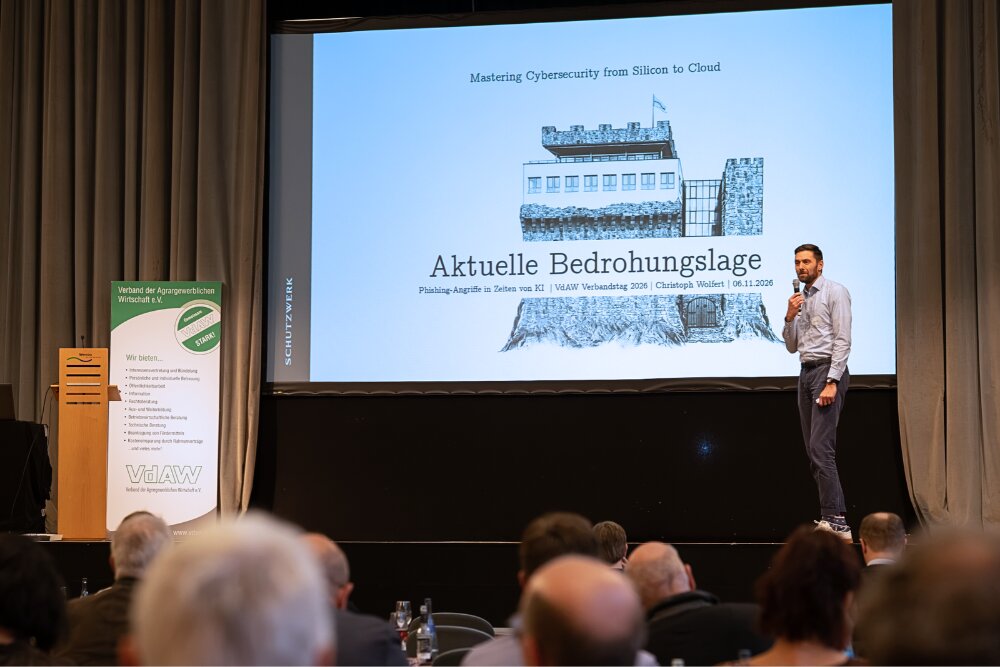
On 6 November 2026, SCHUTZWERK attended the Verbandstag, the annual association conference, of the VdAW (Verband der Agrargewerblichen Wirtschaft e.V., the German association of agricultural trade businesses) in Wernau. Since 2022, SCHUTZWERK GmbH has supported the VdAW with regular online training sessions on cybersecurity, which are available to the association’s members for training and professional development.
At this year’s conference, Christoph Wolfert gave an overview of the current cybersecurity threat landscape, focusing on phishing attacks in the age of AI.
Phishing in the age of AI
Phishing remains an effective and widespread form of attack. Alongside technical vulnerabilities, the human factor plays a decisive role: in social engineering, attackers deliberately exploit human traits such as trust, helpfulness, respect, curiosity, or fear to provoke specific reactions.
With current developments in artificial intelligence (AI), such attacks are becoming increasingly difficult to recognize. The German Federal Criminal Police Office’s BundeslagebildCybercrime2025 (national cybercrime report, German) also notes that cybercriminals use AI to carry out attacks faster, more precisely, and more professionally. AI generates realistic, error-free text and makes it easier to build fake websites.
Communication channels that were previously considered trustworthy, such as phone calls or video conferences, are also affected: deepfakes can convincingly imitate a person’s voice and appearance – now also in real time, which makes calls and video conferences particularly dangerous. One example is CEO fraud, in which employees believe they are talking to the managing director in a video call. In a widelyreportedcasefromHongKong (German), an employee transferred almost 24 million euros to fraudsters after a video conference in which all other participants were AI-generated fakes.
Christoph Wolfert demonstrated how little effort this now takes: a deepfake call using text-to-speech and an image-to-video avatar could be created in around 30 minutes. Open-source software for real-time face swapping is also freely available, although convincing results require many high-quality recordings of the target person.
Training and assessments
Despite these developments, there are still effective ways to protect against such attacks. One key message of the talk: IT security must not depend on the actions of individual employees. Effective protection only comes from combining organizational measures with multi-layered technical measures.
On the organizational side, Christoph Wolfert recommended regular training and awareness measures, clear rules such as reporting obligations and confirmation processes without exceptions, and a plausibility check for any kind of contact – even if you believe you know the person. If employees receive a call urgently requesting a money transfer, for example, verifying through a second channel helps: calling back on the known phone number, or asking a question only the real person can answer. On the technical side, measures include the principle of least privilege, multi-factor authentication across the board, network segmentation, patch management, and backups.
Whether these measures hold up in a real situation can be verified under realistic conditions with PhishingAwarenessAssessments or SocialEngineeringAssessments .
Many thanks to the VdAW for the invitation and to all participants for their interest and the open exchange. Cybersecurity is not a one-time task but an ongoing process – and it starts with taking risks seriously and preparing for them together.
A detailed description of the topics and content of the VdAW Verbandstag 2026 can be found in the VdAWnewsletterforNovember2026(PDF,German) .
If you have questions about phishing risks or raising your employees’ security awareness, please contactus .